North Carolina Department Of Health And Human Services Partners With Count The Kicks
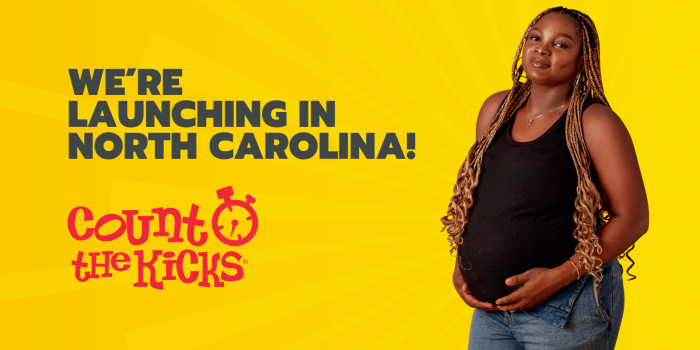
North Carolina Department of Health and Human Services (NCDHHS) is partnering with Count the Kicks, an evidence-based stillbirth prevention program, to educate expectant parents about the importance of paying attention to their baby’s movements in the third trimester of pregnancy. Research shows at least 25% of stillbirths are potentially preventable.
Henderson Lafond is one of three Count the Kicks ambassadors in North Carolina. In 2015, her daughter, Madison, was stillborn in after changes in her movement went unrecognized.
The Centers for Disease Control & Prevention (CDC) lists a change in a baby’s movements as one of its 15 urgent maternal warning signs. Research shows a change in a baby’s normal movement pattern is sometimes the first or only indication there may be an issue developing during the pregnancy.
“Nobody had ever told me that a change in my baby’s movements was a warning sign, or that I should call right away,” said Lafond. “I advocated to bring Count the Kicks to North Carolina so no mom here has to learn that the way I did.”
By making movement monitoring (also known as kick counting) easy and accessible for moms, Count the Kicks and NCDHHS are working together to improve birth outcomes for moms and babies in North Carolina, sometimes saving two lives at once.
After a few days using the FREE Count the Kicks mobile app (available in 20+ languages), web-based counting platform or counting on a paper chart, expectant parents will begin to see a pattern, a normal amount of time it takes their baby to get to 10 movements. If their baby’s “normal” changes during the third trimester, this could be a sign of potential problems and is an indication that the expectant parent should call their health care provider right away.
“After losing our son Jace to stillbirth, I know the heartbreak of leaving the hospital without your baby. I advocated to bring Count the Kicksto North Carolina because every family deserves information that helps them recognize changes in their baby’s movements and feel empowered to speak up. My hope is that this education leads to earlier conversations, timely care, and more babies coming home safely. For my family, this work is one way we honor Jace’s life and the future we dreamed of for him. His legacy lives in our commitment to helping other families have that future.”
– Tomeka Isaac, North Carolina Ambassador and Executive Director of Jace’s Journey
Goal of the Partnership
Thanks to the partnership with NCDHHS, maternal health providers, birthing hospitals, social service agencies, childbirth educators and other providers in North Carolina can order FREE Count the Kicks educational materials to help them have a conversation about baby’s movement patterns with expectant parents. These materials are available in English, Spanish and Haitian Creole.
“In 2005, just three days before my scheduled delivery, we learned there was no heartbeat. I believe that knowing and tracking Helen’s movement pattern — and acting when it changed — might have helped us seek care sooner. Her stillbirth was a devastating loss, followed by grief, isolation and severe postpartum depression, anxiety and PTSD. As a bereaved mom and maternal mental health provider, I work to raise awareness about stillbirth prevention and ensure families can access compassionate mental health support. Honoring Helen means helping others feel informed, heard and less alone.”
– Katherine Hyde-Hensley, North Carolina Ambassador
Impact of Stillbirth in North Carolina
Stillbirth is commonly defined as the loss of a baby at 20 weeks or greater gestation during pregnancy. It is a national public health crisis that impacts more than 20,000 families in the U.S. every year, according to the CDC. Every year 705 North Carolina families experience the tragedy of stillbirth. For expectant parents in the state, one in every 173 births ends in stillbirth.
Disparities in stillbirth outcomes persist, and data shows that a disproportionate number of babies are born still to Native Hawaiian or Other Pacific Islander, Black, and American Indian or Alaska Native families. Expectant parents in some age groups, geographic locations, and those expecting multiples also face an increased risk of stillbirth.
“Learning that your baby has died after a ‘textbook’ perfect pregnancy is a system failure. Every parent deserves the care they need to bring their baby home safely, including detailed education on fetal movement and what to do if they notice a change. As a bilingual Latina, I advocate for every family to be informed about kick counting in their language, and to be able to communicate with their providers to receive urgent, potentially life-saving care. Our son Owen’s stillbirth was preventable, caused by abnormalities in his cord and placenta. I believe babies like him could have a better chance of survival if parents know the warning signs and aren’t blindsided at the end, like we were.”
– Ana Lepe Vick, Count the Kicks Influencer Advisory Board Member, PUSH for Empowered Pregnancy Cofounder
Research on Count the Kicks
Count the Kicks helps improve birth outcomes for moms and babies. Research published in BJOG: An International Journal of Obstetrics and Gynaecology demonstrates the effectiveness of Count the Kicks as a method for stillbirth prevention. The results have led researchers to call for urgent action to address the stillbirth crisis in the U.S. and to study Count the Kicks on a national level.
NCDHHS is joining communities across the country in reducing the rate of stillbirth through the evidence-based Count the Kicks program. The goal is to save approximately 176 babies in North Carolina each year.


Easy Delivery!
Sign up for our newsletter to get the latest information about our mission, events, volunteer opportunities, and more.